📚 Advanced Modeling of Thermodynamic Energy Components and Systems
Volume 1 of “Engineering Thermodynamics: Advanced Modeling of Energy Systems and Nuclear Cycles”
From fundamentals to professional-grade component analysis and off-design operation
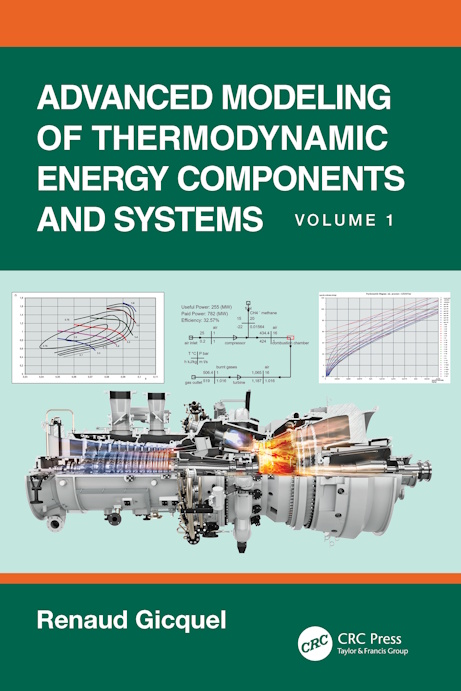
Welcome to the Companion Website
This website complements Advanced Modeling of Thermodynamic Energy Components and Systems, the first volume of the advanced series building upon the pedagogical foundation established in Energy Systems: A New Approach to Engineering Thermodynamics (2021).
🎯 Why This Volume?
You’ve mastered the basics from the 2021 edition. Now it’s time to go deeper.
While the 2021 book introduced thermodynamic cycles with a simplified, accessible approach, Volume 1 takes you to the professional level by focusing on:
✅ Realistic component modeling – Technological constraints, performance laws, efficiency variations
✅ Off-design operation – System behavior under actual operating conditions (part-load, varying ambient)
✅ Component sizing – Geometric dimensioning and detailed internal analysis
✅ Systemic integration – Understanding component coupling through functional and exergy structures
✅ External class development – Extending Thermoptim with custom Java components and controllers
📕 Order This Volume
Advanced Modeling of Thermodynamic Energy Components and Systems is published by Routledge/Taylor & Francis Group (2026).
ISBN: 9781032997865
📄 Building on the Foundation
What You Learned in the 2021 Edition
- Basic thermodynamic cycles (Rankine, Brayton, refrigeration)
- Visual modeling with Thermoptim
- Fundamental component functions
- Phenomenological models for cycle studies
- Simplified performance calculations
What Volume 1 Adds
- Technological models: Material limits, efficiency laws, surge margins, volumetric efficiency
- Off-design simulation: Coupled systems, external controllers, nonlinear equation solving
- Advanced methods: Exergy structures, functional structures, NTU method, performance maps
- Component depth: Displacement and dynamic compressors, turbines, heat exchangers (multi-zone, two-phase)
- Extensibility: External classes for custom substances, specialized components, and controllers
- Real-world validation: Case studies using official industrial data (EPR turbine, steam plants, refrigeration)
Think of it this way:
📘 2021 Edition = Understanding what components do (phenomenological models)
📗 Volume 1 = Understanding how to size components and predict off-design behavior (technological models)
📖 What This Volume Covers
Part I: Methodological Foundations (Chapters 1-5)
Chapter 1: Presentation of the Approach
- Two-level methodology for energy systems
- Functional and exergy structures
- Thermoptim primitive types and external class mechanism
- Three component model categories
Chapter 2: Thermodynamics Fundamentals
- Essential concepts (open/closed systems, state variables)
- First and Second Laws, exergy
- Substance properties (perfect gases → real fluids)
- Thermodynamic diagrams and moist mixtures
Chapter 3: Basic Components and Processes
- Compressions, expansions, combustion, throttling
- Moist mixture treatments (air conditioning)
- Irreversibilities and efficiency definitions
- Dimensionless parameters and performance characterization
Chapter 4: Heat Exchangers
- LMTD and NTU methods
- Effectiveness for various configurations
- Matrix formulation for complex networks
- Pinch point analysis and Thermoptim implementation
Chapter 5: External Class Development
- Custom substances (Dowtherm A, LiBr-H₂O mixtures)
- Specialized components (solar collectors, cooling towers)
- External controllers for optimization
- Java development environment and GUI design
Part II: Component Sizing and Off-Design Behavior (Chapters 6-9)
Chapter 6: Component Sizing and Off-Design Operation
- Phenomenological vs. technological models
- Heat exchanger sizing (NTU method refinements)
- Displacement compressor models (swept volume, efficiency laws)
- Refrigeration cycle example with coupled thermal balances
Chapter 7: Sizing and Off-Design Behavior of Heat Exchangers
- Pressure drop calculations (single-phase and two-phase)
- Heat transfer modeling (extended surfaces, Nusselt correlations)
- Nucleate boiling in steam generators (TechnoSteamGenerator)
- Multi-zone exchangers and geometric parameter estimation
Chapter 8: Modeling and Setting of Displacement Compressors
- Volumetric efficiency (λ) and isentropic efficiency (ηs)
- Loss mechanisms (dead space, pressure drops, thermal effects, leakage)
- Five-parameter and three-parameter efficiency models
- Fixed internal volume ratio (Vi) and over/under-compression
Chapter 9: Modeling and Setting of Dynamic Compressors and Turbines
- Velocity triangles and similarity laws
- Rateau coefficients, degree of reaction
- Performance maps (corrected speed, corrected flow)
- Stodola’s cone rule and Baumann’s efficiency degradation
- Pumps, fans, and leaving losses
Part III: Case Studies (Chapter 10)
Progressive complexity with real-world applications:
Air piston compressor with storage and exchanger cooling
- Controller creation, Wang-Chi-Chang correlation
Refrigeration machine off-design behavior
- MinPack for 6 coupled nonlinear equations
- Variable pressures with external conditions
Simplified steam power plant performance
- Stodola’s rule, multi-zone exchangers
- Parametric variations (cooling water, pressure, superheat)
Flamanville 3 EPR turbine part-load operation (30-100%)
- Official EDF data analysis
- Polytropic efficiency variations, separator performance
- Development of NUSCLE software for nuclear WCR modeling
🔧 Exclusive Resources on This Website
Here you’ll find direct links to advanced tools:
✅ Advanced Thermoptim Models: All book examples with performance maps and technological constraints
✅ External Class Libraries: Java modules for custom controllers, specialized components, and property servers
✅ Off-Design Case Studies: Real plant data (EPR turbine analysis, steam plants, refrigeration systems)
✅ Excel Spreadsheets: Exergy balance tools, data analysis utilities, parameter identification
✅ Technical Documentation: Implementation guides for external classes and controllers
👥 Who Should Read This Volume?
| Reader Profile | Why This Book | Prerequisites |
|---|---|---|
| Graduate students (MSc/PhD) | Bridge academic knowledge and industrial practice | Strong thermodynamics foundation |
| Practicing engineers | Model real systems with technological accuracy | Industry experience + 2021 edition |
| Researchers | Access state-of-the-art component modeling | Advanced degree or equivalent |
| Energy consultants | Perform professional-grade off-design analysis | Technical background |
| Educators | Advanced curriculum for component design | Teaching experience in thermodynamics |
Prerequisites: Solid understanding of basic thermodynamic cycles (as covered in the 2021 edition or equivalent)
🔗 Navigate the Complete Series
🔹 📚 Series Portal — All Three Volumes — Overview of the complete series, coverage table, and recommended learning paths
📘 Energy Systems (2021) – The Foundation
- Broad coverage: All energy technologies
- Simplified pedagogy: Accessible to all (Modes 1-2)
- Phenomenological models: Thermodynamic cycle understanding
- What/Why focus: Understanding energy conversion principles
→ Start here if you’re new to energy systems thermodynamics
📗 Volume 1 (2026) – THIS VOLUME: Component Mastery
- Realistic component modeling: Performance laws and constraints
- Off-design operation: Part-load, sizing, coupled systems
- External classes: Custom Java development
- How focus: Understanding actual component behavior
- Mode 3 (In-Depth) only
→ Continue here after mastering fundamentals
📕 Volume 2 (2026) – Nuclear Specialization
- Nuclear reactor cycles: PWR, BWR, SMR, Gen IV
- Complete plant analysis: NUSCLE and advanced models
- Applied expertise: Nuclear-specific thermodynamics
- Modes 2 & 3 (Progressive & In-Depth)
→ Specialize here for nuclear applications
🚀 What You’ll Gain
✅ Professional modeling skills: Size components and predict off-design performance matching industrial standards
✅ Off-design expertise: Analyze real-world operation beyond design-point conditions
✅ Systemic thinking: Use functional and exergy structures to understand component coupling
✅ Advanced Thermoptim mastery: Develop external classes and custom controllers in Java
✅ Validation capabilities: Compare models against real plant data (EPR, steam plants, refrigeration)
✅ Career readiness: Apply techniques used in energy industry and research laboratories
📥 Getting Started
Essential Downloads
- Thermoptim Software – Free demo includes all Volume 1 features
- External Class Libraries – Advanced component models and development kit
Recommended Learning Path
- Review fundamentals from 2021 edition if needed (Chapters 1-11 minimum)
- Master Part I (Chapters 1-5) – Understand systemic methodology and external classes
- Study Part II (Chapters 6-9) – Component sizing and off-design behavior
- Apply Part III (Chapter 10) – Work through progressive case studies
- Develop custom models – Extend Thermoptim for your specific applications
💡 Key Features of This Volume
| Aspect | 2021 Edition | Volume 1 |
|---|---|---|
| Component models | Phenomenological (design-point) | Technological (sizing + off-design) |
| Operating analysis | Nominal conditions | Part-load, varying ambient |
| Thermoptim usage | Core features | External classes + controllers |
| Fluid modeling | Basic real fluids | Advanced (moist mixtures, custom substances) |
| System analysis | Energy balances | Functional & exergy structures |
| Validation | Textbook examples | Real industrial data (EPR turbine) |
| Pedagogy | Modes 1-2 (accessible) | Mode 3 (professional depth) |
💬 Connect with the Community
📧 Technical support
📚 Thermoptim-UNIT Portal
🎓 From This Volume to Professional Practice
Immediate Applications:
- Size heat exchangers, compressors, and turbines for real projects
- Predict off-design performance of energy systems
- Develop custom Thermoptim external classes for specialized components
- Analyze part-load operation using industrial performance maps
- Validate models against plant data
Career Paths:
- Energy system design engineer
- Performance analyst for power plants
- R&D specialist in component optimization
- Energy consultant (technical analysis)
- Academic researcher in applied thermodynamics
Next Steps:
- Apply NUSCLE methodology (from EPR case study) to nuclear plants
- Continue to Volume 2 for nuclear specialization
- Develop custom external classes for your industry
- Contribute to open-source Thermoptim ecosystem
© Renaud Gicquel, 2026