📚 Energy Systems: A New Approach to Engineering Thermodynamics (2nd Ed.)
The Pedagogical Foundation for Modern Energy System Education
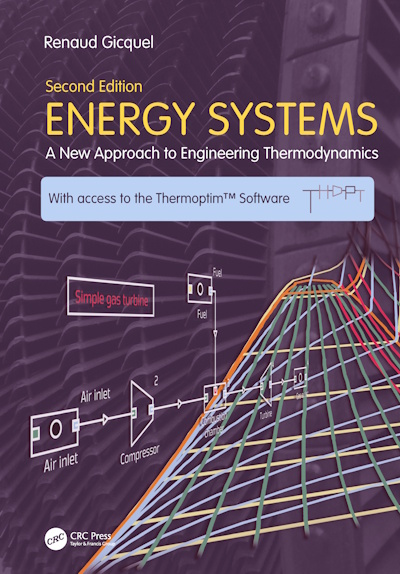
Welcome to the Companion Website
This website complements Energy Systems: A New Approach to Engineering Thermodynamics (2nd Ed.), the foundational volume of a three-book series that revolutionizes energy systems education.
It explains how this book is part of a set of three books that allow you to start by learning about thermal energy systems and then conduct in-depth studies on two particularly important topics:
- the behavior of these systems under off-design conditions,
- and thermodynamic cycles coupled with nuclear reactors.
It also lists the various educational activities announced in the boxes of the different chapters of this book.
🌟 The Book That Changed Thermodynamics Education
For 25 years, we’ve pioneered a revolutionary approach to teaching thermodynamics—without overwhelming mathematics, using interactive simulations and real-world applications. This book is the gateway to understanding energy systems through:
✅ Graphical Systemic Modeling: Build and analyze cycles visually with Thermoptim
✅ Simplified Theory: Focus on physical concepts, equations introduced only when needed
✅ Broad Coverage: From steam plants to fuel cells, from refrigeration to renewable energy
✅ Progressive Learning: Two of the three pedagogical modes adapted to all levels
📕 Order This Volume
Energy Systems: A New Approach to Engineering Thermodynamics is published by Routledge/ Taylor & Francis Group (2021).
ISBN: 9781032007748
🎯 Why This Book Is Unique
This 2021 edition is the foundational volume that established a new paradigm in thermodynamics education:
| What Makes It Different | Traditional Textbooks | Our Approach |
|---|---|---|
| Starting Point | Abstract equations first | Visual system understanding first |
| Actual Examples | Simplified cycles | Real-world cycles, no need to simplify |
| Complexity | Mathematical formalism required | Simplified presentation, math when needed |
| Scope | Narrow specialization | Comprehensive coverage of energy technologies |
| Target Audience | Advanced engineering students | Technicians to engineers (all levels) |
| Learning Tools | Theoretical problems | Interactive Thermoptim simulations |
Key Innovation: The CFRP approach (Components, Functions, Reference Processes) allows learners to understand thermodynamic systems qualitatively before tackling quantitative analysis.
👥 Who Is This Book For?
This edition serves the broadest possible audience:
- 🔧 Technicians & Operators: Visual understanding of system operation (Mode 1 - Streamlined)
- 🎓 Undergraduate Students: Design and optimization fundamentals (Mode 2 - Progressive)
- 👨🏫 Educators: Complete teaching framework with ready-to-use resources
- 💼 Professionals in Continuing Education: Quick access to modern energy systems
- 🌍 International Learners: Available in English and French
Not ready for advanced component modeling or nuclear cycles? This is your starting point.
Already familiar with basics? Explore Volume 1 or Volume 2 for deeper specialization.
📖 Comprehensive Coverage of Energy Technologies
Unlike specialized textbooks, this edition covers the full spectrum of thermodynamic energy systems:
🔥 Power Generation
- Steam power plants (Rankine or Hirn cycles, reheat, regeneration)
- Gas turbines (Brayton cycles, regeneration, aircraft propulsion)
- Internal combustion engines (reciprocating, Diesel, Otto)
- Combined cycles
- Cogeneration and CHP systems
❄️ Refrigeration & Air Conditioning
- Vapor compression cycles
- Absorption refrigeration (LiBr-H₂O, NH3-H₂O)
- Heat pumps
- Cryogenic cycles
- Psychrometrics and HVAC design
🌱 Renewable & Innovative Energy
- Solar thermodynamic systems
- Geothermal and OTEC cycles
- Biomass energy conversion
- Stirling engines
- Advanced gas turbine cycles (humid air, supercritical CO₂)
⚡ Emerging Technologies
- Fuel cells (SOFC, PEM)
- Electrolyzers and hydrogen production
- Desalination systems
- Future nuclear reactor cycles (Gen IV)
- Oxyfuel combustion
Total: 18 chapters covering over 40 different cycle types and applications.
🎓 Two Pedagogical Modes for Progressive Mastery
Our adaptive methodology ensures the book serves learners at the two first stages, the third one being fully addressed in the 2026 volumes.
Mode 1: Light
For: Technicians, operators, vocational training, MOOCs
Focus: Visual understanding, system operation, troubleshooting
Tools:
- Diapason narrated slideshows
- Guided explorations (step-by-step)
- Drag-and-drop, gap-fill, categorization self-assessments
- No entropy, no exergy — just practical thermodynamics
Outcome: Operate and diagnose energy systems confidently
Mode 2: Progressive
For: Undergraduate students, practicing engineers
Focus: Cycle design, performance optimization, comparative analysis
Tools:
- Start with Mode 1 foundation
- Introduction to entropy and exergy after mastering basics
- Additional self-assessment exercises
- Spiral learning (concepts revisited with increasing depth)
- Exergy analysis and pinch method
Outcome: Design and optimize conventional energy systems
Mode 3: In-Depth (Introduced, completed in Volumes 1-2)
For: Graduate students, researchers, advanced practitioners
Focus: Innovation, theoretical validation, advanced simulations
Tools:
- Complete equation sets
- Advanced Thermoptim features (external class development)
- Component sizing and off-design system behavior
- Custom controller development
Outcome: Create novel cycles and push technological boundaries
For a deeper understanding of these topics, two notes expand on the pedagogical use of Thermoptim: the first elaborates on the new educational paradigm it enables, while the second addresses its theoretical foundations.
🎯 Interactive Learning Resources on This Website
Beyond the textbook, this companion website provides comprehensive interactive resources organized for easy access:
📋 Suggested Activities
A complete guide to all learning materials, organized by activity type:
- Key Issues — 20 essential concepts to master
- Guided Explorations — 45+ step-by-step Thermoptim simulations
- Worked Examples — 15+ real-world case studies with complete solutions
- Self-Assessment — 70+ interactive exercises (drag-drop, gap-fill, categorization, quizzes)
- Online Course 2022 — Structured learning pathway for Modes 1-2
Why visit this page?
- Find activities organized by activity type
- Access all digital resources in one convenient location
- Follow recommended learning paths for different skill levels
🔹 Browse All Suggested Activities — Your interactive learning companion
“Think of this as your digital laboratory — everything you need to practice, explore, and master energy systems modeling is organized here.”
🔧 Essential Digital Tools
Every chapter is supported by comprehensive digital resources:
| Resource Type | Description | Access |
|---|---|---|
| Thermoptim Models | Pre-built simulations of all major cycles | Download |
| Guided Explorations | 45+ step-by-step tutorials | Portal |
| Diapason Sessions | 30+ narrated slideshows with audio guidance | Portal |
| Self-Assessment | 70+ interactive exercises | Portal |
| Online Course 2022 | Complete Mode 1 + partial Mode 2 | Course |
🔗 Your Path Through the Complete Series
This book is the pedagogical foundation. The 2026 volumes build upon it for specialized, advanced study:
🔹 📚 Series Portal — All Three Volumes — Overview of the complete series, coverage table, and recommended learning paths
📘 Energy Systems (2021) — THIS BOOK
- Scope: Broad coverage of all energy technologies
- Pedagogy: Simplified, accessible to all levels (Modes 1-2)
- Depth: Introductory to intermediate
- Goal: Understand the fundamentals of thermal energy conversion
→ Start here if: You’re new to thermodynamics OR need a comprehensive overview OR prefer simplified explanations
📗 Volume 1: Advanced Modeling of Energy Components (2026)
- Scope: Deep dive into component behavior and systemic analysis
- Pedagogy: Technical, assumes foundational knowledge (Mode 3)
- Depth: Advanced — off-design operation, performance maps, technological constraints
- Goal: Master realistic component modeling
→ Continue here if: You’ve mastered the basics AND want to model real components accurately AND need off-design analysis
📕 Volume 2: Nuclear Power Plant Thermodynamic Cycles (2026)
- Scope: Specialized focus on nuclear thermodynamic cycles
- Pedagogy: Advanced-level, assumes 2021 edition knowledge (Modes 2-3)
- Depth: Highly specialized — PWR, BWR, SMR, Gen IV, supercritical CO₂, cogeneration
- Goal: Model and optimize complete nuclear plant cycles
→ Continue here if: You’re motivated by nuclear energy AND need detailed cycle analysis AND want real plant case studies
📥 Getting Started
Essential Downloads
- Thermoptim Software — Free demo version
- Thermoptim-UNIT Portal — All digital resources
- Self-Assessment Exercises — Test your knowledge
© Renaud Gicquel, 2021.2