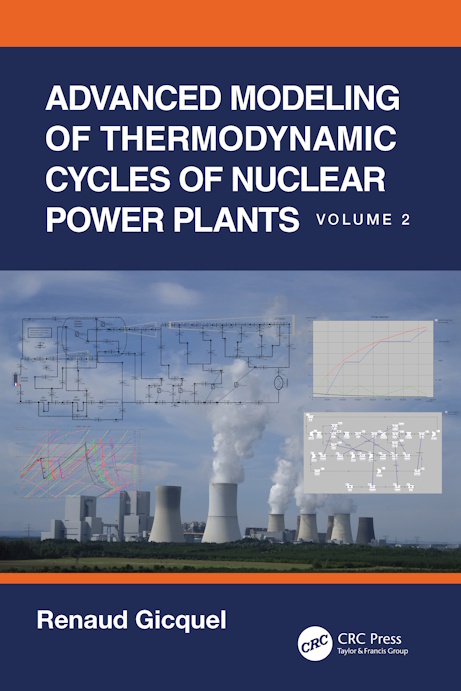
📚 Advanced Modeling of Thermodynamic Cycles of Nuclear Power Plants
Volume 2 of “Engineering Thermodynamics: Advanced Modeling of Energy Systems and Nuclear Cycles”
Bridging theory and industrial practice for nuclear energy systems
Welcome to the Companion Website
This website complements Advanced Modeling of Thermodynamic Cycles of Nuclear Power Plants, the second volume of the advanced series that applies the complete Thermoptim methodology to the specialized field of nuclear energy.
☢️ Why This Volume?
You’ve mastered energy systems fundamentals and component modeling. Now specialize in the most complex and strategically critical application: nuclear power plant thermodynamic cycles.
While the 2021 edition introduced nuclear cycles at a simplified level, and Volume 1 provided advanced component modeling tools, Volume 2 delivers:
✅ Complete nuclear plant cycle analysis – All major reactor types from PWR to Gen IV
✅ Real plant case studies – 11 detailed models with official regulatory data
✅ Specialized applications – Cogeneration, desalination, hydrogen production
✅ Advanced cycles – Supercritical CO₂, combined cycles, high-temperature systems
✅ Strategic perspective – Technology readiness levels, deployment scenarios
✅ Innovative pedagogy – Reducing formalism while maintaining rigor through Thermoptim
📕 Order This Volume
Advanced Modeling of Thermodynamic Cycles of Nuclear Power Plants is published by Routledge/ Taylor & Francis Group (2026).
ISBN: 9781032997872
📄 Building on Both Foundations
What You Learned in the 2021 Edition
- Basic nuclear reactor concepts (PWR, BWR)
- Simplified steam cycles
- Introduction to future nuclear systems (Chapter 15)
- Visual modeling fundamentals
What Volume 1 Added
- Realistic component behavior and performance maps
- Off-design analysis methods and external controllers
- Advanced heat exchanger modeling (critical for steam generators)
- Exergy analysis framework and functional structures
- NUSCLE (Nuclear Secondary Circuit Lite Emulator) from EPR case
What Volume 2 Delivers
- Nuclear reactor physics: Fission, moderation, containment, safety systems
- Complete secondary cycles: Systematic analysis of all major reactor types
- Reactor type comparison: PWR, BWR, CANDU, fast reactors, HTR, MSR, SMR
- Advanced nuclear cycles: sCO₂ Brayton, combined cycles, supercritical steam
- Multi-use integration: Electricity + heat + desalination + hydrogen
- Real plant validation: 11 case studies with official data (AGR, ABWR, EPR, etc.)
The progression:
📘 2021 Edition = Understanding nuclear cycles conceptually
📗 Volume 1 = Mastering the component tools and off-design methods
📕 Volume 2 = Applying everything to complete nuclear plant systems
📖 What This Volume Covers
Part I: Nuclear Foundations and Methodology
Introduction: Strategic and Methodological Context
- Unique work bridging theory and industrial practice
- Industrial and strategic challenge of nuclear energy
- Systemic and analytical modeling with powerful tools
- Technology Readiness Level framework
Chapter 1: Systems Approach and Innovative Teaching with Thermoptim
- Analysis of energy systems: Functional and exergy structures
- New pedagogical paradigm: Reducing mathematical formalism, visual modeling
- CFRP approach: Inductive progression (Conceptualize, Formalize, Represent, Perform)
- Thermoptim as teaching tool: Interactive simulation, immediate feedback
Chapter 2: Physical Phenomena and Panorama of Nuclear Reactors
- Atomic structure, uranium fission, chain reaction control
- Comprehensive reactor survey: PWR, VVER, BWR, RBMK, SCWR, AGR, CANDU, SFR, FNR, LFR, HTR, VHTR, MSR, FMSR
- Generations of reactors (Gen I through Gen IV)
- Mind maps and comparative tables
Part II: Core Nuclear Thermodynamic Cycles
Chapter 3: Steam and Gas Power Cycles - Understanding, Analysis, and Improvement
- Carnot cycle effectiveness and constraints
- Reference cycles: Hartlepool AGR (steam, 41%), HTR helium cycle
- Methodological tools: Thermoptim simulator, exergy balances, pinch method
- Comparison with Carnot in entropy diagrams
Chapter 4: Improvement of Steam Power Cycles
- Exergy analysis: Reveals ≈50% irreversibilities in economizer
- Reheat cycles: Several percentage points efficiency gain
- Regenerative cycles: Feedwater heating reduces irreversibilities
- Hartlepool AGR case: Progressive modeling, multiple extractions
- Supercritical cycles: 47-48% efficiency, Canadian SCWR (48.73%)
- Advanced reactors: SFR, HTR-PM, MSR
Chapter 5: Medium Temperature Steam Power Cycles
- Water-cooled reactors (PWR, BWR, RBMK, CANDU): 95% of global fleet
- Impossibility of significant superheating (safety constraints)
- Moisture separator reheater (MSR): Design and impact
- Expansion in wet steam region: Baumann’s rule (-1% per quality point)
- NUSCLE framework: Simplified modeling tool
- ORC and binary cycles for low-temperature heat
Chapter 6: Improvement of Closed Cycle Gas Turbines
- Simple helium cycle: 22.85% → Regenerative: 40.41% → Combined: 47.4%
- Supercritical CO₂ cycles:
- Simple regeneration: 34%
- Recompression: 45% efficiency
- Partial cooling: 43.7%
- Critical challenges: Cp variations, temperature crossover, cold source <25°C
- Technology Readiness: sCO₂ TRL 6-7, helium <7
Part III: Special Applications
Chapter 7: Combined Cycles, Desalination, Hydrogen, Cogeneration
- Combined cycles: Dual-pressure helium-steam (48.73%), Areva GT-MHR (47%, 65.6% exergy)
- Desalination: MED, MSF, RO, MVC (steam consumption reduction by 3x)
- Hydrogen production:
- Steam methane reforming with complex equilibrium
- High-temperature electrolysis (HTE) at 800-1000°C
- Nuclear cogeneration: Overall efficiency >80%
- Gösgen NPP: 54 MW process steam
- Areva Antares: 58.9% overall efficiency
- PWR-desalination: 31.19% electrical + 40 kg/s water
Part IV: Real Plant Case Studies
Chapter 8: Case Studies - 11 Comprehensive Analyses
| Plant | Reactor Type | Power (MWe) | Efficiency | Key Features |
|---|---|---|---|---|
| AGR | Gas-cooled | 650 | 41% | 8 feedwater heaters, MSR, CO₂ |
| NuScale 50 | SMR (PWR) | 50 | ≈30% | Natural circulation, passive safety |
| NuScale 77 | SMR (PWR) | 77 | ≈30% | Upgraded module |
| ABWR | BWR | 1350 | ≈34% | 11 extractions, direct cycle, MSR |
| RBMK | Graphite-water | 1000 | ≈31% | Sealing steam evaporators |
| VVER | PWR variant | 1000 | ≈33% | Hexagonal assemblies, horizontal SG |
| CANDU | Heavy water | 550 | ≈30% | Natural uranium, lower temp |
| Superphénix | Fast (Na) | 1174 | 40% | Highly superheated steam (487°C) |
| HTR-PM | High-temp (He) | 67 | 33.76% | 40% design target, TRISO fuel |
| Canadian SCWR | Supercritical | 1250 | 48.73% | Gen IV, once-through |
| EPR Flamanville 3 | PWR (Gen III+) | 1650 | ≈36% | Off-design 30-100% load, external controllers |
Each case study includes:
- Complete Thermoptim model of secondary cycle
- Steam/feedwater circuit descriptions
- Turbine configurations and extraction flows
- Feedwater heater arrangements (3-8 heaters)
- Validation against official nuclear regulatory data
- Comparative analysis in Mollier diagrams
Appendices: Essential Reference Material
Appendix 1: Reminders
- Thermodynamic diagrams: (h, ln(P)), (T, s), (h, s) Mollier
- NTU method: Heat exchanger calculation, thermocouplers
- Performance characterization: Isentropic/polytropic efficiency, Baumann’s rule
Appendix 2: Turbines
- Steam turbines: velocity profiles, degree of reaction, Stodola’s law, Baumann’s rule
- Gas turbines: closed-cycle vs. combustion, comparison table
🔧 Exclusive Nuclear Resources
This website provides specialized tools for nuclear applications:
✅ Complete Plant Models: Ready-to-run Thermoptim projects for all 11 case studies
✅ Reactor-Specific Controllers: Java modules for PWR/BWR steam generator modeling
✅ Nuclear Data Libraries: Fluid properties at nuclear operating conditions
✅ Guided Nuclear Explorations: Step-by-step tutorials for reactor cycle analysis
✅ Validation Datasets: Real plant performance data for model verification
👥 Who Should Read This Volume?
| Reader Profile | Why This Book | Prerequisites |
|---|---|---|
| Nuclear engineering students | Master thermodynamic aspects of reactor systems | Strong thermodynamics foundation |
| Practicing engineers | Optimize secondary cycle performance | Industry experience + Volume 1 |
| Energy policy analysts | Compare nuclear technologies systematically | Technical background |
| Research scientists | Explore advanced nuclear cycle concepts | Advanced degree or equivalent |
| Educators | Advanced curriculum for nuclear thermodynamics | Teaching experience |
Prerequisites:
- Strong foundation in thermodynamics (2021 edition or equivalent)
- Component modeling skills (Volume 1 recommended)
- Basic nuclear physics knowledge helpful (provided in Chapter 2)
🔗 Navigate the Complete Series
🔹 📚 Series Portal — All Three Volumes — Overview of the complete series, coverage table, and recommended learning paths
📘 Energy Systems (2021) – The Foundation
- Broad coverage including basic nuclear introduction (Chapter 15)
- Simplified pedagogy: Accessible to all (Modes 1-2)
- Visual modeling fundamentals
→ Start here if new to energy systems or nuclear basics
📗 Volume 1 (2026) – Component Mastery
- Realistic component modeling: Performance maps, off-design analysis
- Advanced methods: External classes, controllers, NUSCLE development
- Heat exchanger, turbine, and pump modeling essentials
→ Essential preparation for professional nuclear cycle modeling
📕 Volume 2 (2026) – THIS VOLUME: Nuclear Specialization
- Complete nuclear plant cycles: All major reactor types
- Real plant validation: 11 detailed case studies
- Strategic technology assessment: TRL, deployment pathways
- Multi-use applications: Beyond electricity
→ Specialize here for nuclear energy applications
🌍 Strategic Context: Nuclear Renaissance
The global energy transition has reignited interest in nuclear power:
- Existing fleet optimization: Extending lifetime, improving efficiency (400+ reactors)
- New builds: Gen III+ reactors (EPR, AP1000, VVER-1200)
- Small Modular Reactors: Flexible deployment, enhanced safety (NuScale, etc.)
- Generation IV: High-temperature, fast spectrum, molten salt (HTR-PM operational)
- Multi-use applications: Hydrogen production, desalination, process heat
This volume provides the analytical foundation for informed decision-making across this landscape.
🚀 What You’ll Gain
✅ Nuclear cycle expertise: Model any reactor type’s thermodynamic performance
✅ Technology evaluation skills: Systematically compare nuclear options (11 case studies)
✅ Strategic insight: Link technical performance to TRL and deployment scenarios
✅ Professional tools: Thermoptim models matching industry-standard approaches
✅ Pedagogical mastery: Innovative teaching methods reducing mathematical formalism
✅ Future readiness: Understand emerging technologies (sCO₂, HTR, MSR, SMR)
📥 Getting Started
Essential Downloads
- Thermoptim Software – Free demo with nuclear cycle capabilities
- 11 Nuclear Plant Models – Complete case studies
- External Nuclear Classes – Reactor-specific controllers (steam generators, etc.)
- Validation Datasets – Official regulatory data
Recommended Learning Path
- Review Volumes 2021 + 1 if needed for thermodynamics and component foundations
- Study nuclear physics (Chapter 2) – Understand reactor constraints
- Master methodological tools (Chapter 3) – Thermoptim, exergy, pinch
- Work through improvements (Chapters 4-6) – Steam, gas, sCO₂ cycles
- Explore applications (Chapter 7) – Cogeneration, desalination, hydrogen
- Apply to case studies (Chapter 8) – 11 real plants, start with familiar type
💡 Why Systemic Modeling Matters for Nuclear Energy
In an era where nuclear decisions span decades and billions of euros:
- Transparent analysis enables informed policy choices
- Open models support educational competency development
- Comparative frameworks facilitate technology evaluation (11 reactors compared)
- Realistic simulations bridge engineering and strategy
- Innovative pedagogy makes complex subject accessible
This volume empowers students, engineers, and decision-makers with the analytical tools for the nuclear energy transition.
🎓 Unique Pedagogical Approach
| Aspect | Traditional Teaching | This Volume |
|---|---|---|
| Mathematics | Heavy formalism | Reduced, visual modeling emphasized |
| Learning | Deductive (theory→practice) | Inductive (CFRP: cases→principles) |
| Tools | Hand calculations or proprietary | Thermoptim (open, interactive) |
| Validation | Textbook problems | Real plants (11 with official data) |
| Coverage | Single reactor type | All major types systematically |
| Applications | Electricity only | Multi-use (H₂, desalination, CHP) |
Innovation: Maintains scientific rigor while emphasizing qualitative understanding, autonomy, and connection to industrial practice.
Support
📧 Nuclear applications support
📚 Thermoptim-UNIT Portal
🔬 From This Volume to Professional Practice
Immediate Applications:
- Nuclear plant performance analysis and optimization
- Technology evaluation for new builds (Gen III+, SMR, Gen IV)
- Research on advanced cycles (sCO₂, combined, supercritical)
- Educational curriculum development with innovative pedagogy
Strategic Value:
- Informed decision-making on nuclear energy policy
- Independent technology assessment capability
- Educational competency and sovereignty
- International collaboration with common analytical language
Career Paths:
- Nuclear plant thermodynamic engineer
- Reactor design specialist (secondary cycle)
- Energy policy analyst (nuclear technologies)
- R&D researcher (advanced cycles)
- Educator (innovative teaching methods)
© Renaud Gicquel, 2026